
If you’ve ever sent a B2B email campaign and heard nothing but crickets, you’re not alone. The culprit is almost always the same: a poorly targeted email list. Getting email marketing right in the B2B world isn’t about blasting thousands of contacts — it’s about reaching the right people at the right companies with the right message.
In this guide, you’ll learn exactly how to build a targeted B2B email list that drives real pipeline, not just open rates. These five proven steps are used by top-performing sales and marketing teams to consistently fill their calendars with qualified meetings.
Let’s dive in.
Step 1: Define your Ideal Customer Profile (ICP) with precision
Before you collect a single email address, you need to know exactly who you’re trying to reach. This is where most B2B companies go wrong — they cast too wide a net and end up with a list full of contacts who will never buy.
Your Ideal Customer Profile (ICP) is a detailed description of the type of company that gets the most value from your product or service. Building one requires you to look at your existing best customers and identify common patterns.
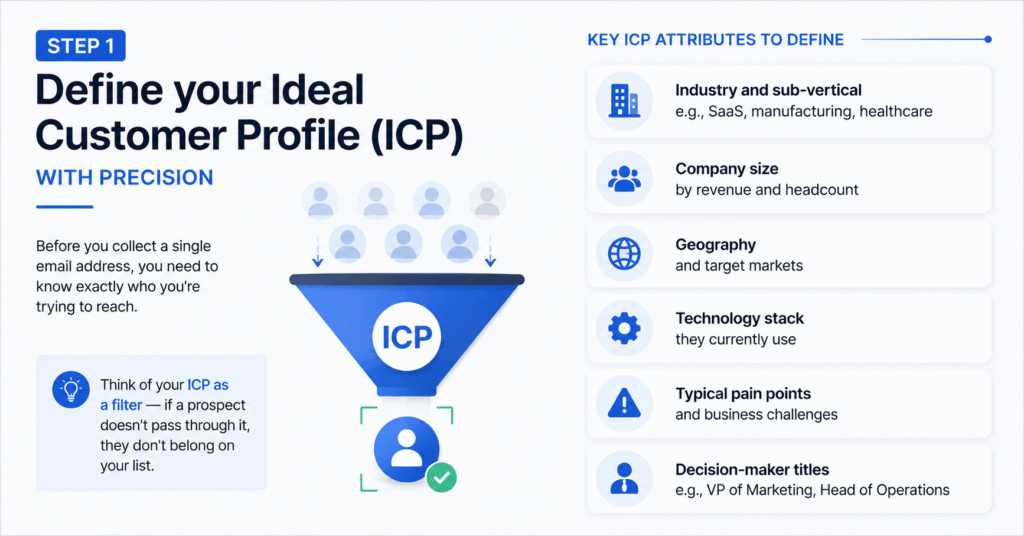
Key ICP attributes to define:
- Industry and sub-vertical (e.g., SaaS, manufacturing, healthcare)
- Company size by revenue and headcount
- Geography and target markets
- Technology stack they currently use
- Typical pain points and business challenges
- Decision-maker titles (e.g., VP of Marketing, Head of Operations)
Once your ICP is locked in, every contact you add to your list should match it. Think of your ICP as a filter — if a prospect doesn’t pass through it, they don’t belong on your list.
Step 2: Leverage the right data sources to find verified contacts
Knowing who you want to reach is half the battle. The other half is finding them. There are two main approaches to building your B2B email list: inbound and outbound data sourcing.
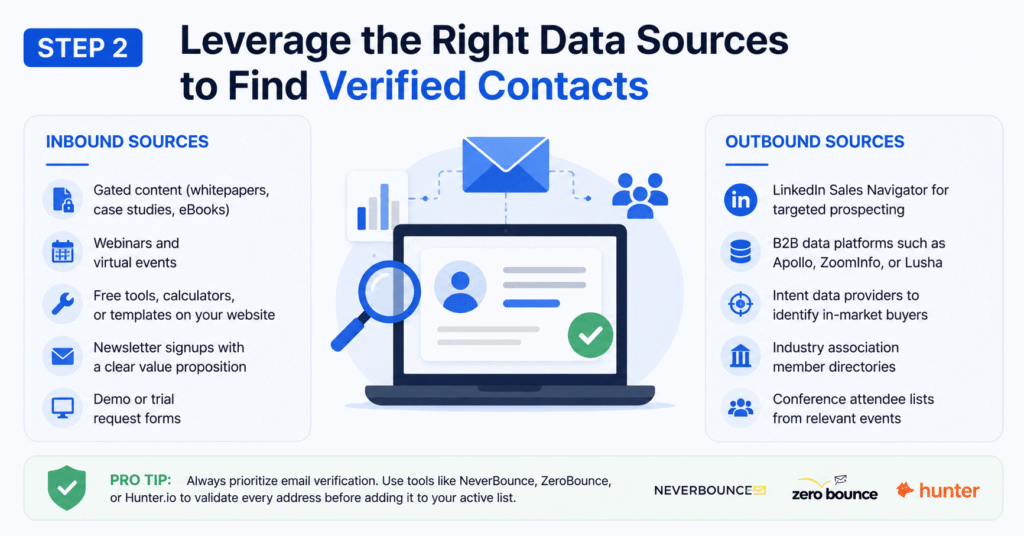
Inbound sources:
- Gated content (whitepapers, case studies, eBooks)
- Webinars and virtual events
- Free tools, calculators, or templates on your website
- Newsletter signups with a clear value proposition
- Demo or trial request forms
Outbound sources:
- LinkedIn Sales Navigator for targeted prospecting
- B2B data platforms such as Apollo, ZoomInfo, or Lusha
- Intent data providers to identify in-market buyers
- Industry association member directories
- Conference attendee lists from relevant events
Pro tip: Always prioritize email verification. Use tools like NeverBounce, ZeroBounce, or Hunter.io to validate every address before adding it to your active list. A high bounce rate damages your sender reputation and gets your domain blacklisted.
Step 3: Segment your list for maximum relevance
A targeted B2B email list isn’t a single monolithic database — it’s a collection of carefully organized segments. Segmentation allows you to send the right message to the right subset of your audience, dramatically increasing engagement and conversion rates.
According to multiple marketing studies, segmented email campaigns generate significantly higher revenue compared to non-segmented sends. The reason is simple: personalization at scale wins.
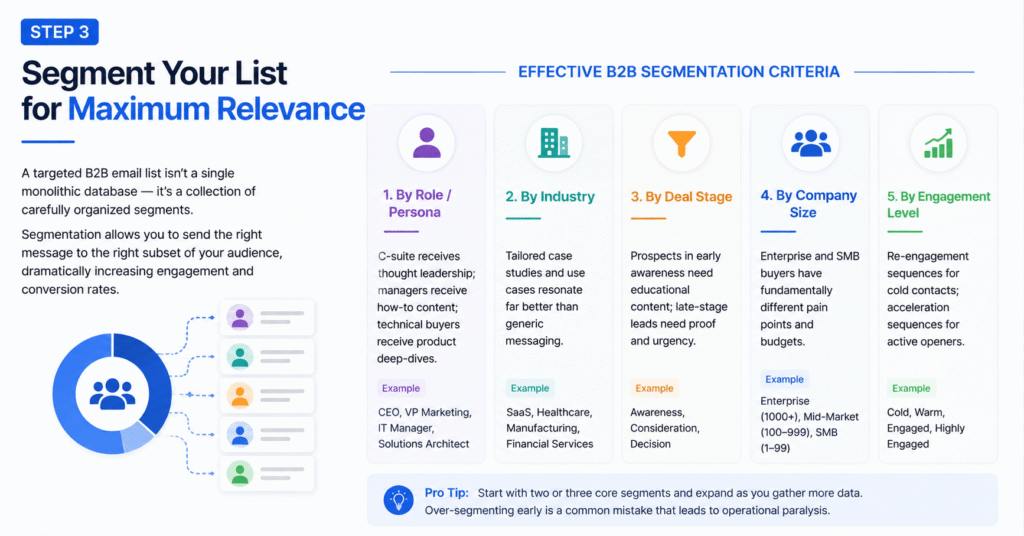
Effective B2B segmentation criteria:
- By role/persona: C-suite receives thought leadership; managers receive how-to content; technical buyers receive product deep-dives
- By industry: Tailored case studies and use cases resonate far better than generic messaging
- By deal stage: Prospects in early awareness need educational content; late-stage leads need proof and urgency
- By company size: Enterprise and SMB buyers have fundamentally different pain points and budgets
- By engagement level: Re-engagement sequences for cold contacts; acceleration sequences for active openers
Start with two or three core segments and expand as you gather more data. Over-segmenting early is a common mistake that leads to operational paralysis.
Step 4: Enrich your data to personalize at scale
An email address alone is just a starting point. To write emails that feel personal and relevant, you need context about each contact. Data enrichment fills the gaps between what you know and what you need to know.
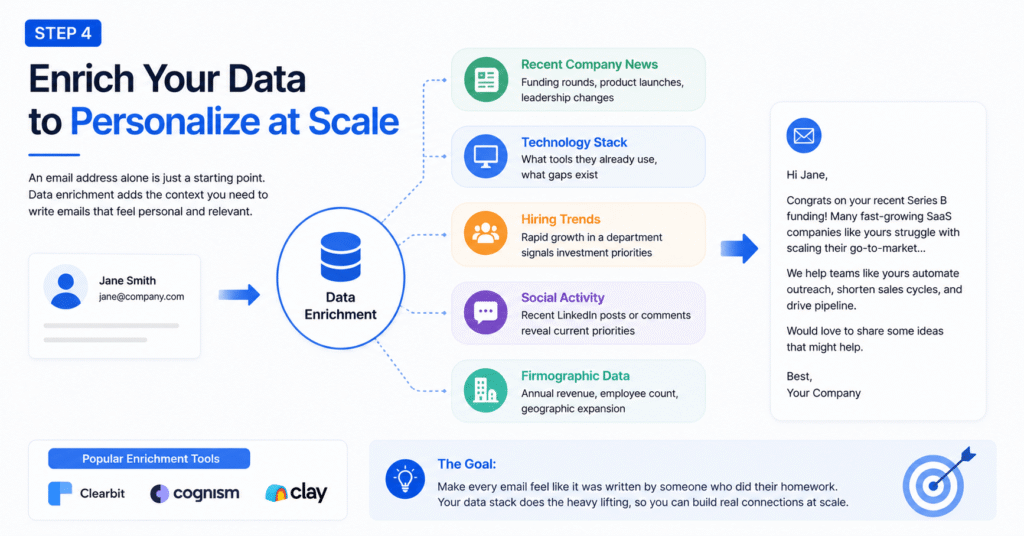
Enrichment data points that drive personalization:
- Recent company news (funding rounds, product launches, leadership changes)
- Technology stack (what tools they already use, what gaps exist)
- Hiring trends (rapid growth in a department signals investment priorities)
- Social activity (recent LinkedIn posts or comments reveal current priorities)
- Firmographic data (annual revenue, employee count, geographic expansion)
Tools like Clearbit, Cognism, and Clay.com can automate enrichment at scale, pulling real-time data into your CRM or email platform. When a prospect opens an email that references their recent Series B funding or their new VP of Sales hire, the response rate climbs sharply.
The goal of enrichment is to make every email feel like it was written by someone who did their homework — because, effectively, your data stack did it for you.
Step 5: Maintain list hygiene to protect deliverability
Building a high-quality B2B email list is not a one-time project — it’s an ongoing process. Even the cleanest list decays over time. Industry research suggests that B2B contact data degrades at a rate of roughly 20–30% per year due to job changes, company restructurings, and domain changes.
A dirty list doesn’t just waste your effort — it actively hurts you. High bounce rates, spam complaints, and low engagement signals all damage your sender reputation, reducing the chance that even your best emails reach the inbox.
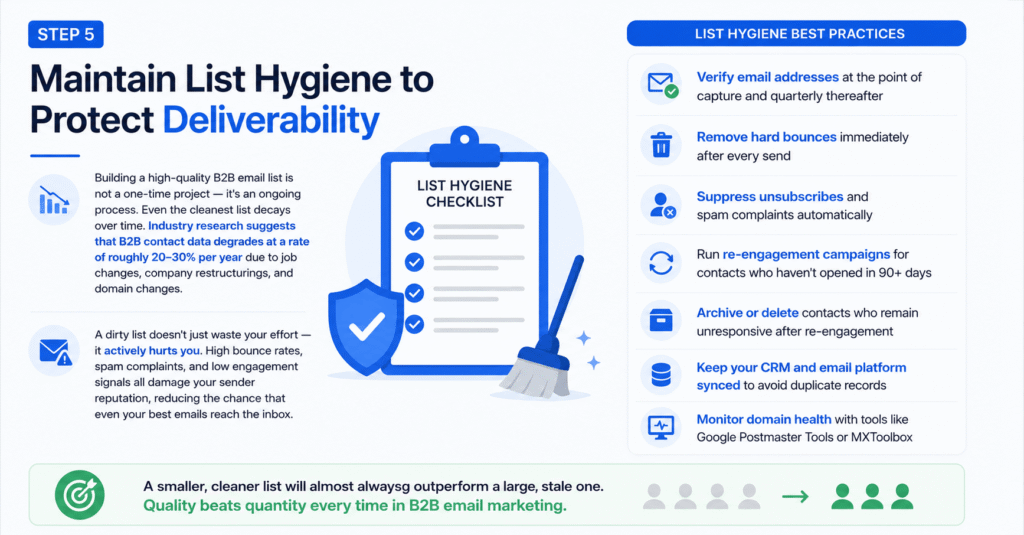
List hygiene best practices:
- Verify email addresses at the point of capture and quarterly thereafter
- Remove hard bounces immediately after every send
- Suppress unsubscribes and spam complaints automatically
- Run re-engagement campaigns for contacts who haven’t opened in 90+ days
- Archive or delete contacts who remain unresponsive after re-engagement
- Keep your CRM and email platform synced to avoid duplicate records
- Monitor domain health with tools like Google Postmaster Tools or MXToolbox
A smaller, cleaner list will almost always outperform a large, stale one. Quality beats quantity every time in B2B email marketing.
Final thoughts: your list is your most valuable B2B asset
Learning how to build a targeted B2B email list is one of the highest-ROI skills in modern sales and marketing. When you combine a precise ICP, verified data, smart segmentation, rich personalization, and disciplined list hygiene, you create a growth engine that compounds over time.
The companies that win at B2B email aren’t necessarily sending more emails — they’re sending smarter ones, to fewer, better-qualified people. That starts with the list.
Start with Step 1 today. Revisit your ICP, audit your current list against it, and remove anyone who doesn’t fit. That single action will immediately improve the performance of every campaign you run going forward.